The short answer
What is Morocco’s Route of 1000 Kasbahs?
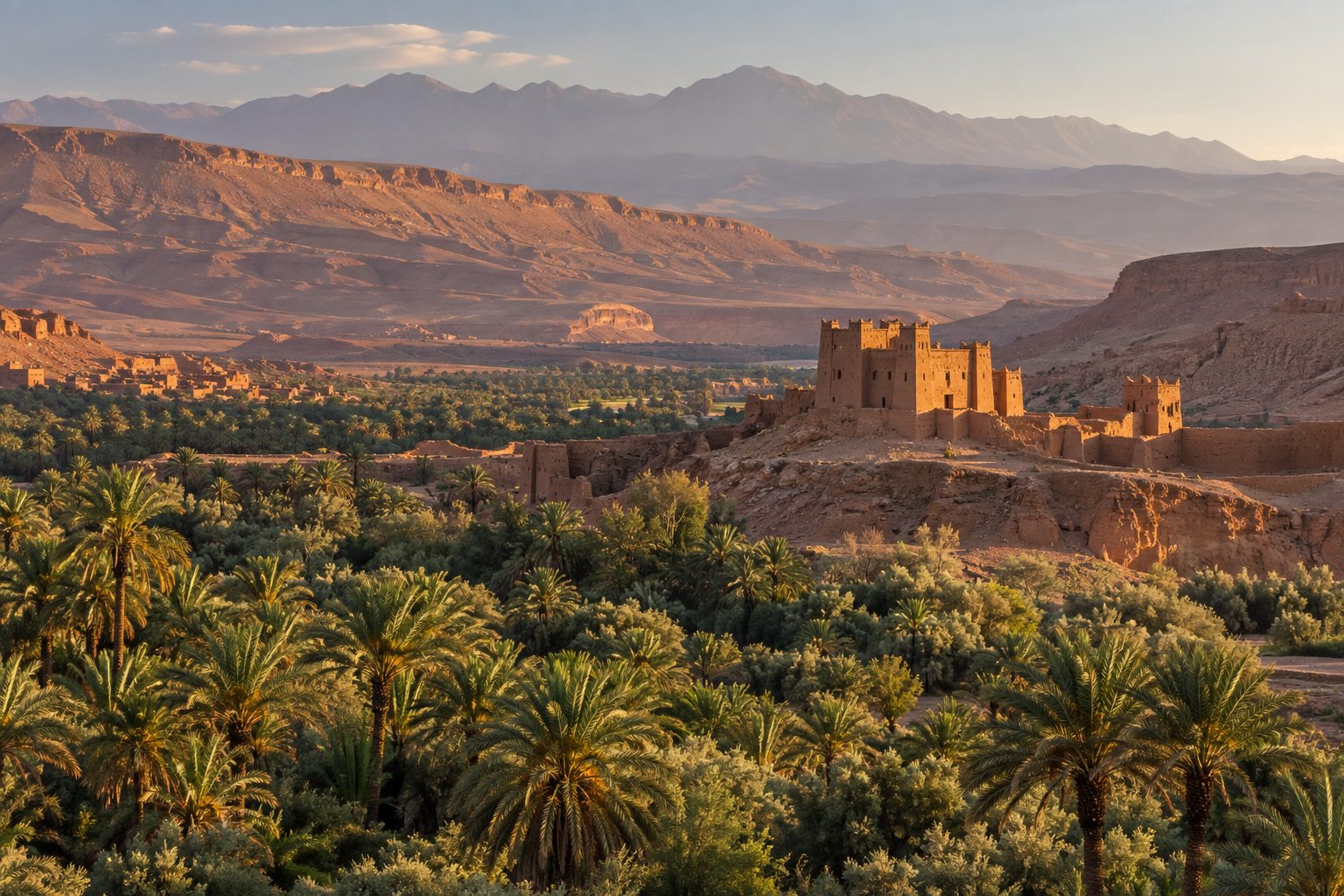
The Route of 1000 Kasbahs Morocco is a popular name for a southern road-trip corridor shaped by palm oases, river valleys and earthen architecture. A practical eastbound version starts around Ouarzazate, pauses in Skoura, crosses the Valley of Roses and Dadès country, then reaches Tinghir and Todra Gorge. Some travelers begin farther west at Aït-Ben-Haddou or continue southeast to Merzouga.
It is not one fenced attraction, one official motorway or a literal checklist of exactly one thousand buildings. Route definitions vary. The value lies in reading the landscape slowly: irrigated palms below, fortified earth buildings above, villages along the valley and geology changing between each stage.
The Moroccan National Tourist Office uses the “road of the thousand kasbahs” idea for journeys through southern palm groves, rose gardens and fortified landscapes. This independent guide turns that broad inspiration into a usable Ouarzazate-to-Tinghir plan, with Skoura as the place where a road trip becomes a lived oasis experience.
The Morocco kasbah route at a glance
This sequence is logical rather than compulsory. Aït-Ben-Haddou sits west of Ouarzazate and works as a separate detour or preceding night. UNESCO describes its ksar as an outstanding example of southern Moroccan earthen architecture and a traditional pre-Saharan habitat; it deserves enough time to be understood, not simply collected on the same overloaded day.
If your schedule gives every place twenty minutes, you are seeing the road but missing the route. Protect at least one half-day for a walk, ride or hosted visit away from the car.
How many days should you allow?
1 day
Ouarzazate to Dadès with brief stops is possible, but it is a transfer day. Choose only two priority stops and avoid promising yourself every viewpoint.
2 days
Sleep in Skoura or Dadès. You can explore one oasis properly, enjoy the light at both ends of the day and continue without constant clock-watching.
3+ days
Add village walks, a guided activity, a longer Dadès section or Todra. This is the better rhythm for photography, families and cultural curiosity.
For an Ouarzazate to Dadès road trip, two days is the useful sweet spot. If you continue to the Sahara, add the desert as its own stage. Our Skoura or Ouarzazate to Merzouga guide explains the faster two-day option and its trade-offs.
Five stops that make the Road of a Thousand Kasbahs memorable
1. Ouarzazate: orient before driving east
Use Ouarzazate to organize fuel, cash, accommodation and the next stage. The city is more useful as a calm base than as a frantic checklist. If you have only one free day, compare the pacing in our Ouarzazate-to-Skoura day-trip plan.
2. Skoura: leave the main road
Skoura’s interest begins where the asphalt stops dominating the view. Palm-shaded tracks reveal gardens, irrigation channels, villages and earth buildings as one connected landscape. Read the best things to do in Skoura, then choose a guided oasis experience.
3. Kelâat M’Gouna and the Rose Valley
The landscape west and north of Kelâat M’Gouna is known for rose cultivation, but the valley is not only a spring event. Villages, fields and river terraces remain part of the journey year-round. In flowering season, expect more roadside activity and allow extra time.
4. Boumalne Dadès and the gorge road
Boumalne is the decision point between continuing east and turning into the Dadès Valley. The gorge road rewards gradual exploration: terraces, rock formations, settlements and high viewpoints. Set a turnaround time before driving deep into a side valley.
5. Tinghir and Todra Gorge
Tinghir’s palm belt gives the route another oasis scale before the cliffs narrow at Todra. Walk only where conditions and access are suitable, respect working agricultural paths and avoid treating residents’ doorways as public photo sets.
Aït-Ben-Haddou or Merzouga
Choose Aït-Ben-Haddou as a western heritage extension or Merzouga as an eastern desert extension. Adding both to a short itinerary creates more driving than discovery. For the Sahara option, see the private Merzouga tour.
A realistic two-day Route of 1000 Kasbahs itinerary
Ouarzazate to Skoura
Leave after breakfast rather than before dawn. Arrive with time to look beyond the roadside. If the trip begins in Marrakech, avoid assuming the High Atlas crossing and a full oasis visit fit comfortably into the same daylight window.
Explore Skoura Oasis
Plan a guided walk, bike tour or cultural route. A local-scale activity makes the palm grove legible and gives context to the buildings you will see from the road later.
Stay for the soft light
Spend the night in or near Skoura. Late light gives texture to earthen walls, while an overnight removes the pressure to race toward Dadès before dark.
Skoura to the Rose Valley
Continue toward Kelâat M’Gouna. Choose one deliberate village or valley stop instead of pulling over repeatedly on unsafe road edges.
Dadès Valley or onward to Tinghir
Turn north at Boumalne for a Dadès exploration, or continue toward Tinghir if Todra is the priority. Trying to explore both deeply in one afternoon defeats the slow-road character.
Sleep near the next day’s priority
Stay in Dadès for the gorge road, or in Tinghir for an early Todra visit. If your next stage is Merzouga, confirm driving time and arrival arrangements with your accommodation or guide.
Kasbah, ksar and tighremt: what do the words mean?
Travel marketing often uses “kasbah” for almost every picturesque earth building. The landscape becomes more interesting when the terms are kept distinct. Usage varies by language and place, so treat this as a practical orientation rather than a rigid glossary.
| Term | Useful meaning | How to visit thoughtfully |
|---|---|---|
| Kasbah | A fortified stronghold or residence in common travel usage | Check access; many are private, fragile or not maintained as museums |
| Ksar | A fortified village with multiple homes, lanes and shared spaces | Remember that a heritage setting may still be a lived community |
| Tighremt | An Amazigh term commonly used for a fortified multi-storey house or granary-like residence | Ask before entering or photographing people and domestic areas |
Kasbah Amridil is a well-known Skoura landmark, but it should not stand in for the entire oasis. The independent Ksour & Kasbahs Atlas entry for Amridil provides architectural context; a local outing can then connect that monument with paths, farms and water systems around it.
Driving and planning advice for the kasbah road
- Download an offline map. Mobile coverage can vary, and a saved route helps at valley junctions.
- Drive in daylight. Road edges, pedestrians, animals, bicycles and unlit vehicles can be harder to read after dark.
- Fuel before side valleys. Top up in the larger towns rather than building the day around an uncertain final station.
- Do not trust map time as visit time. Navigation estimates exclude photographs, meals, construction, viewpoints and walking.
- Use safe pull-offs. A beautiful view is not permission to stop on a bend or block a village entrance.
- Check current conditions. Heavy rain, heat, mountain weather and road works can change access. Ask locally on the day.
- Carry cash and water. Small purchases and rural stops may not accept cards; refill responsibly rather than relying on single-use bottles.
- Choose the season for your priorities. Our best-time-to-visit-Skoura guide compares heat, light, crowds and outdoor comfort.
Distances and travel times change with the exact detours you choose. Rather than publishing a deceptively precise total, build the day in sections and confirm live road conditions before departure.
How to photograph earthen heritage respectfully
Walls, rooftops and lanes may look timeless, but many spaces are homes, farms or vulnerable structures. Ask before photographing people. Do not climb on parapets, enter unlocked-looking buildings without permission or fly a drone without checking the current legal and local rules. A guide can identify public paths and explain why regular maintenance matters for rammed-earth architecture.
For cycling photographers, a slow approach works especially well: ride between wider views and stop on suitable ground. Compare our complete cycling guide to Skoura and the guided VTT excursion before choosing your route.
Frequently asked questions
Where does the Route of 1000 Kasbahs begin and end?
There is no single official gate or fixed endpoint. Most practical plans use Ouarzazate as the western base and continue east through Skoura, the Rose Valley, Dadès and Tinghir, with Todra or the Sahara as an extension.
Are there literally one thousand kasbahs?
The name is an evocative travel label for the concentration of earthen settlements and fortified residences across southern Morocco, not a promise of exactly one thousand visitor attractions.
How many days do I need for the Road of a Thousand Kasbahs?
Two days allow a balanced one-way journey between Ouarzazate and Tinghir. Three or more days are better if you want walks, local visits and time in Skoura rather than only roadside photographs.
Is Skoura worth an overnight stop?
Yes. Staying overnight creates time to explore the palm grove, understand its irrigation landscape and take a walking, cycling or cultural excursion without rushing onward.
What is the difference between a kasbah and a ksar?
In travel usage, a kasbah often refers to a fortified residence or stronghold, while a ksar is a fortified village containing multiple homes and shared spaces. Local terminology is more nuanced and tighremt is also used for fortified houses.
Can I continue from this route to Merzouga?
Yes. Many itineraries continue from Tinghir toward the Tafilalt region and Merzouga. Allow enough time and treat the Sahara extension as a separate road stage rather than squeezing it into a short kasbah day.
Sources and editorial method
This guide combines local route knowledge with authoritative heritage and destination references. It does not copy a packaged itinerary, and route definitions are described as variable rather than falsely official.
- Moroccan National Tourist Office: Road of the Kasbahs
- UNESCO World Heritage Centre: Ksar of Aït-Ben-Haddou
- Ksour & Kasbahs Atlas: Kasbah Amridil
Published and checked: 2 October 2026. Roads, access, opening arrangements and weather can change; confirm current local conditions before travel.